Prompt engineering is simply the skill of writing clear instructions—or prompts—to get a generative AI model to give you exactly what you want. Think of it less like coding and more like being an incredibly precise communicator. You're learning to "talk" to the AI in a way that produces accurate, creative, and genuinely useful results.
The Art of Giving AI Great Directions
Imagine you’re trying to get directions from a GPS that’s brilliant but takes everything you say literally. If you just say, "Take me somewhere nice," you could end up anywhere. You might get a scenic route that adds an hour to your trip or a shortcut through a sketchy neighborhood. It's a total gamble.
To get where you actually want to go, you need to be specific: "Find the fastest route to the coffee shop on Main Street, avoiding all toll roads."
That’s the core idea behind prompt engineering. It’s the difference between a vague wish and a clear, actionable command that guides the AI away from generic noise and toward a high-quality, relevant output.
A bad prompt is a shot in the dark. A great prompt is like a blueprint—it gives the AI the context, constraints, and a clear picture of the final product you have in mind.
When you master this, you stop being a passive user and become an active collaborator. You’re not just asking a question; you're setting the stage for the AI to perform at its best.
The Anatomy of a Powerful Prompt
A truly effective prompt isn't just one instruction; it's a combination of several key ingredients that work together to guide the AI. Getting these right is the first step to predictable, high-quality results. Let's break down the essential components that turn a simple request into a powerful command.
The Anatomy of a Powerful Prompt
| Component | Description | Example Snippet |
|---|---|---|
| The Task | What you want the AI to do. Be direct and use action verbs. | "Summarize this article..." |
| The Context | Key background information the AI needs to complete the task well. | "...the article is for an audience of busy marketing managers." |
| The Persona | Instructing the AI to adopt a specific role, voice, or style. | "Act as an expert copywriter with a witty, engaging tone." |
| The Constraints | Rules and boundaries, like word count, format, or what to avoid. | "Keep the summary under 150 words and present it as 3 bullet points." |
When you start weaving these elements together, you can create prompts that generate anything from on-brand ad copy to functional code snippets.
A fantastic way to see this in action is to explore the various AI Media Studio tools. You'll quickly see how a well-structured prompt can produce professional-grade creative work in seconds. Learning to "talk" to AI this way is no longer a niche skill—it’s fundamental to unlocking its true potential.
How Prompting Grew Up with AI
Prompt engineering didn’t just pop into existence. It grew up right alongside the AI models it guides. If you rewind the clock, early interactions with natural language processing (NLP) were clunky and rigid. You had to use strict, template-based commands, and there was zero room for error. The AI either understood your exact phrase or it threw its digital hands up in failure.
A huge leap forward came with something called attention mechanisms. This was a genuine breakthrough that let AI models figure out which words in a sentence were the most important. All of a sudden, AI could grasp context, making prompts feel more like a conversation and less like a line of code.
The real discipline of prompt engineering started taking shape around 2018. Researchers had a clever idea: what if we frame all sorts of different NLP tasks as simple question-and-answer problems? This unified a bunch of separate processes into one clean strategy. From there, things like reinforcement learning in 2017 added feedback loops, helping the models learn and improve with every interaction. You can explore the history of prompt engineering to see how each step built upon the last one.
From Simple Commands to Complex Conversations
The evolution kept picking up speed. Between 2019 and 2023, the field matured with some seriously powerful techniques that define how we prompt today.
- Multimodal Prompts: AI learned to understand prompts that mixed text with images or other types of data. This blew the doors open for creativity.
- Chain-of-Thought Reasoning: This is a cool one. It encourages a model to "think out loud" step-by-step, helping it tackle tricky logical problems it would otherwise fail.
- Emotional Context: Models also started getting good at recognizing and even replicating emotional tones, adding a whole new layer of depth to the content they could generate.
This timeline shows how the basic building blocks of a prompt came together over time.
Loading image...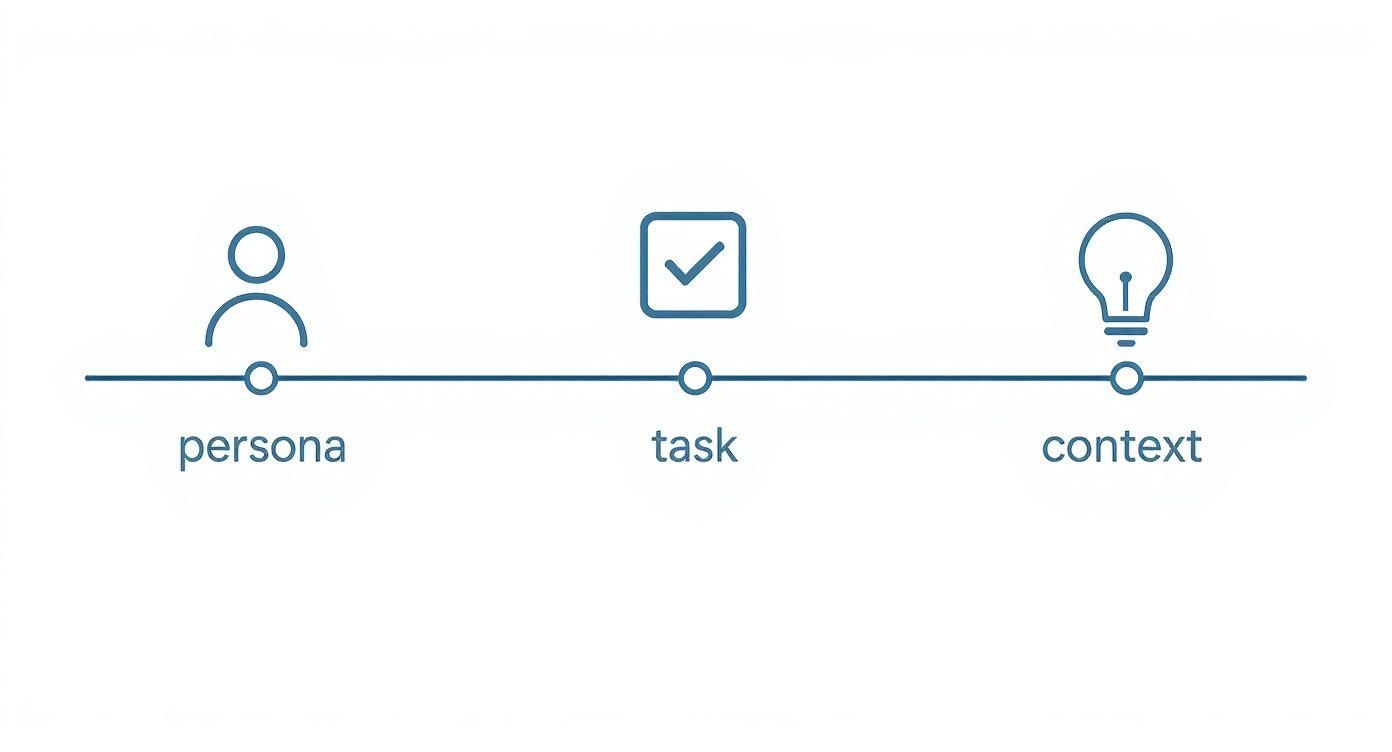
It’s a clear progression from just telling an AI what to do, to giving it a full persona and the deep context it needs to deliver truly incredible results.
Why Mastering Prompts Is a Career Superpower
Loading image...
Knowing how to write a good prompt is about more than just getting a better answer from an AI. It's quickly becoming a genuine strategic advantage in the workplace, helping you work faster, think more creatively, and produce far more accurate work.
Whether you're a marketer trying to nail down ad copy or a developer squashing bugs in code, the ability to clearly guide an AI is a massive productivity multiplier.
Think of it like this: two people can have the same powerful tool, but the one who knows how to use it with skill and precision will always deliver a better result. That's prompt engineering in a nutshell—it's the new operational skill for the AI era.
The real value of prompt engineering lies in its ability to close the gap between human intent and machine execution. Professionals who can bridge this gap are becoming indispensable in nearly every industry.
The Economic Impact of Prompt Engineering
The demand for people who can skillfully talk to AI has absolutely exploded. Job postings that mention "generative AI" shot up by a staggering 36-fold in just one year.
This isn't just hype; it's showing up in paychecks. Some prompt engineering roles are now commanding salaries of over $335,000 per year. This proves that prompt engineering isn’t just a neat party trick—it's a high-value career path where AI development meets real-world business needs.
As every organization from hospitals to consulting firms scrambles to integrate AI, the people who can make it perform reliably are the ones leading the charge. You can read more about the surging demand for AI skills and see just how big the financial impact is.
Essential Techniques for Crafting Better Prompts
Loading image...
Alright, let's move from theory to practice. Great prompt engineering isn't about some secret code; it's about a handful of core techniques that turn a simple question into a powerful instruction. Think of it like a chef using specific methods to bring out the best flavors in food—a prompt engineer does the same to get the most accurate and creative results from an AI.
These techniques are really just principles of clear communication. They’re all about providing crystal-clear context, setting firm boundaries, and even giving the AI a specific role to play to shape its tone. A huge part of this is effective context management in prompts, which is just a fancy way of saying you give the AI exactly what it needs to know, no more, no less.
The goal is to remove guesswork. A well-crafted prompt leaves no room for ambiguity, guiding the AI directly to the desired outcome instead of letting it wander through countless possibilities.
Once you get the hang of a few key approaches, you’ll see a dramatic jump in the quality of your AI interactions. Your outputs will become more predictable, relevant, and genuinely useful.
Advanced Prompting Strategies
Beyond the basics, a few powerful methods have popped up for tackling more complex jobs. These are the strategies that really unlock the next level of what AI can do.
-
Role-Playing Prompts: This is one of the easiest and most effective tricks in the book. By starting your prompt with something like, "Act as an expert copywriter" or "You are a helpful travel agent," you instantly frame the AI's knowledge and set the exact tone you're looking for.
-
Few-Shot Prompting: This technique is all about showing, not just telling. You give the AI a few examples of exactly what you want—a couple of input-output pairs—to teach it the format and style on the fly. This leads to much more consistent results. The idea really took off with models like GPT-3 back in 2020, which proved how a few examples could guide an AI without needing to retrain the whole thing.
-
Chain-of-Thought (CoT) Prompting: For any problem that requires logic or multiple steps, CoT is a total game-changer. By simply telling the AI to "think step-by-step," you force it to break down its reasoning. This simple instruction dramatically improves its accuracy on tough analytical tasks. We actually use similar principles in our own platform for advanced AI image generation features to help it interpret detailed creative ideas.
Putting Prompt Engineering Into Practice
Loading image...
Theory is great, but seeing prompt engineering in action is where the lightbulb really goes on. This isn't just an abstract idea; it's a skill people are using every single day to get things done and open up new possibilities.
Think about it. Marketing teams are crafting hyper-targeted ad copy in minutes. Developers are getting a head start on complex code. A researcher can get the gist of a dense academic paper without spending hours reading it. All of this is powered by precise, well-thought-out prompts.
The real magic happens when you combine clear instructions, the right context, and specific boundaries. This is what steers the AI away from generic answers and toward a genuinely useful, high-quality result.
When you get this right, the AI stops being a simple chatbot and becomes a specialized assistant ready to tackle your specific task.
Real-World Prompt Examples
Let's break down what this looks like with a few concrete examples. Notice how each one tells the AI who to be, what to do, and what rules to follow. This simple structure is the key to getting predictable, focused output.
-
For the Marketer: "Act as a senior copywriter. Write 3 Facebook ad headlines for a new vegan protein powder. The target audience is fitness enthusiasts aged 25-40. The tone should be energetic and motivational. Each headline must be under 12 words and include the phrase 'plant-powered performance'."
-
For the Content Creator: "Generate a script for a 90-second YouTube Short. The topic is 'Three common mistakes to avoid when starting a podcast.' Present the information as a numbered list with a brief, engaging introduction and a call to action to subscribe. The style should be conversational and friendly."
Diving into practical examples with ChatGPT can give you even more ideas on how this works in different scenarios.
This structure is just as crucial for creative work. Here at AI Media Studio, we see our users apply these same principles to our AI video generator. By specifying visual styles, pacing, and narrative details, they're creating amazing videos that would have taken days to produce manually.
Common Questions About Prompt Engineering
As you get started with prompt engineering, a few questions tend to surface right away. It's a skill that's far more about clear communication than it is about deep technical knowledge, and these answers should clear things up.
Do I Need a Technical Background?
Not in the slightest. At its core, prompt engineering is about logical thinking and using precise language—not writing code.
This skill is rooted in how we communicate naturally, which makes it perfect for anyone, from writers and marketers to small business owners. If you want to get better results from your AI tools, this is for you.
Think of it this way: if you can give clear, step-by-step directions to a person, you have what it takes to write a great prompt for an AI. You're just translating your idea into instructions the model can actually follow.
Prompt engineering is less about being a programmer and more about being a great communicator. It’s the art of asking the right questions to get the right answers.
Will AI Make This Skill Obsolete?
It’s true that AI will get much better at understanding vague requests, but the need for precision isn't going anywhere. This is especially true for high-stakes projects or highly creative work.
Imagine a talented employee. They're capable on their own, but a skilled manager providing clear direction is what guarantees the best possible outcome. That's the role you play.
The specific techniques we use today might evolve, but the fundamental skill of guiding AI toward a specific goal will only become more valuable as these tools become a bigger part of our daily work.
What Separates a Good and Bad Prompt?
The biggest difference comes down to two things: clarity and context.
-
A bad prompt is vague. It assumes the AI can read your mind. Something like, "Write about electric cars," will get you a generic, uninspired, and frankly boring response. It's an open invitation for the AI to guess.
-
A good prompt is specific and packed with helpful details. For example: "Write a 500-word blog post with an enthusiastic tone comparing the top three electric sedans for families. Focus on safety ratings, battery range, and cargo space."
This level of detail takes all the guesswork out of the equation. It steers the AI directly toward a high-quality, relevant piece of content every single time.
Paid plans for AI Media Studio start at $19/month.