Of course. Here is the rewritten section, designed to sound completely human-written, match the provided expert style, and meet all formatting and linking requirements.
Yes, a free AI image creator is exactly what it sounds like: a tool that lets anyone generate completely unique, high-quality visuals just by typing a description. Platforms like AI Media Studio even give you a handful of free generations right out of the gate, so you can jump in and start creating immediately.
These tools have completely changed the game, making professional-grade design accessible to everyone, regardless of their budget or artistic skills.
How Free AI Image Creators Are Reshaping the Creative World
We're in the middle of a massive shift in digital content, and accessible AI tools are right at the center of it. What was once the exclusive territory of graphic designers and artists is now wide open.
A small business owner can now mock up an entire ad campaign in an afternoon. A blogger can craft the perfect featured image for their next post without ever leaving their web browser. This isn't just about making things easier; it's about giving everyone the power to create.
This explosion in use is mirrored by the market's incredible growth. The global AI image generator market was valued at USD 9.10 billion in 2024 and is on track to hit an astonishing USD 63.29 billion by 2030. That’s a compound annual growth rate of 38.16% from 2025-2030, which tells you just how deeply these tools are becoming part of our creative workflows.
The chart below shows just how steep that growth curve really is.
This isn't just a trend; it's a clear signal of the massive demand for tools that make creating visuals faster and more intuitive.
Shattering Old Creative Barriers
The real magic of a free AI image creator is its ability to demolish the old walls that stood between an idea and a finished visual. For decades, creating custom images meant dealing with some serious hurdles: the high cost of designers, the long wait times, and the need for specialized software skills.
Tools like AI Media Studio knock down these barriers with a simple interface and a free way to get started.
- No Design Degree Needed: Forget spending years learning complex programs like Photoshop. If you can describe what you want in plain English, you can bring a stunning image to life.
- Results in Minutes, Not Days: Why wait for a designer to send back a first draft? You can generate dozens of different concepts and variations in just a few minutes, letting you experiment and iterate at the speed of thought.
- Zero-Cost to Start: With free credits on the table, anyone from a student working on a project to a startup founder on a shoestring budget can produce professional visuals without spending a dime upfront.
I’ve seen solo entrepreneurs create a complete set of social media graphics for a major product launch in under an hour. Just a few years ago, that level of speed and independence was completely unthinkable.
This visual revolution is happening alongside a broader transformation in AI-powered content creation. The same fundamental principles that allow AI to write an article are now powering this explosion in visual art. As the technology gets smarter, the line between thinking of an idea and actually creating it gets blurrier, opening up a world of possibilities.
You can see these tools in action by exploring the specific image generation capabilities offered by AI Media Studio.
Now, let's break down exactly how this new approach stacks up against the old way of doing things. The table below gives a clear comparison of the core benefits.
Key Benefits of Using a Free AI Image Creator
| Benefit | AI Media Studio (Free Tier) | Traditional Methods (Stock Photos/Hiring Designers) |
|---|---|---|
| Cost | $0 to start creating immediately. | Can range from $10-$50 per stock photo or $50-$500+ per hour for a designer. |
| Speed | Get dozens of image variations in minutes. | Hours or days of searching for the right stock photo or waiting for designer drafts. |
| Uniqueness | Every image is 100% unique and tailored to your prompt. | Stock photos are generic and used by thousands of others; designs are unique but costly. |
| Customization | Infinite customization by simply tweaking your text prompt. | Limited to what's available on stock sites or requires lengthy revision cycles with a designer. |
| Accessibility | No specialized skills required; if you can type, you can create. | Requires design software skills or the ability to write a detailed creative brief. |
As you can see, the advantages in speed, cost, and creative freedom are hard to ignore. For anyone creating content today, integrating a free AI image creator isn't just a novelty—it's a massive competitive advantage.
Creating Your First AI Image in Minutes
Jumping into a free AI image creator should feel like an instant win, not a chore. Forget complicated sign-ups or paywalls. A good platform, like AI Media Studio, gets you from idea to a finished image in minutes, often without even asking for a credit card upfront.
Let's walk through that first creation, from start to finish. The moment you land on the AI Media Studio site, the path is clear. Signing up just takes an email, which immediately unlocks your first set of free credits.
Finding Your Way Around the Dashboard
Once you’re in, you’ll find the dashboard is clean and refreshingly simple. There are no confusing menus to navigate. Your free credits are displayed right where you can see them, so you always know how many image generations you have left.
The main event is the prompt box, sitting front and center. This is where you'll bring your ideas to life.
Just next to it, you'll spot a library of over 50 distinct art styles. This is your creative shortcut for setting the mood. With a single click, you can switch your image from a photorealistic shot to a piece of cyberpunk art or a soft watercolor painting.
The entire workflow boils down to a simple, three-part process.
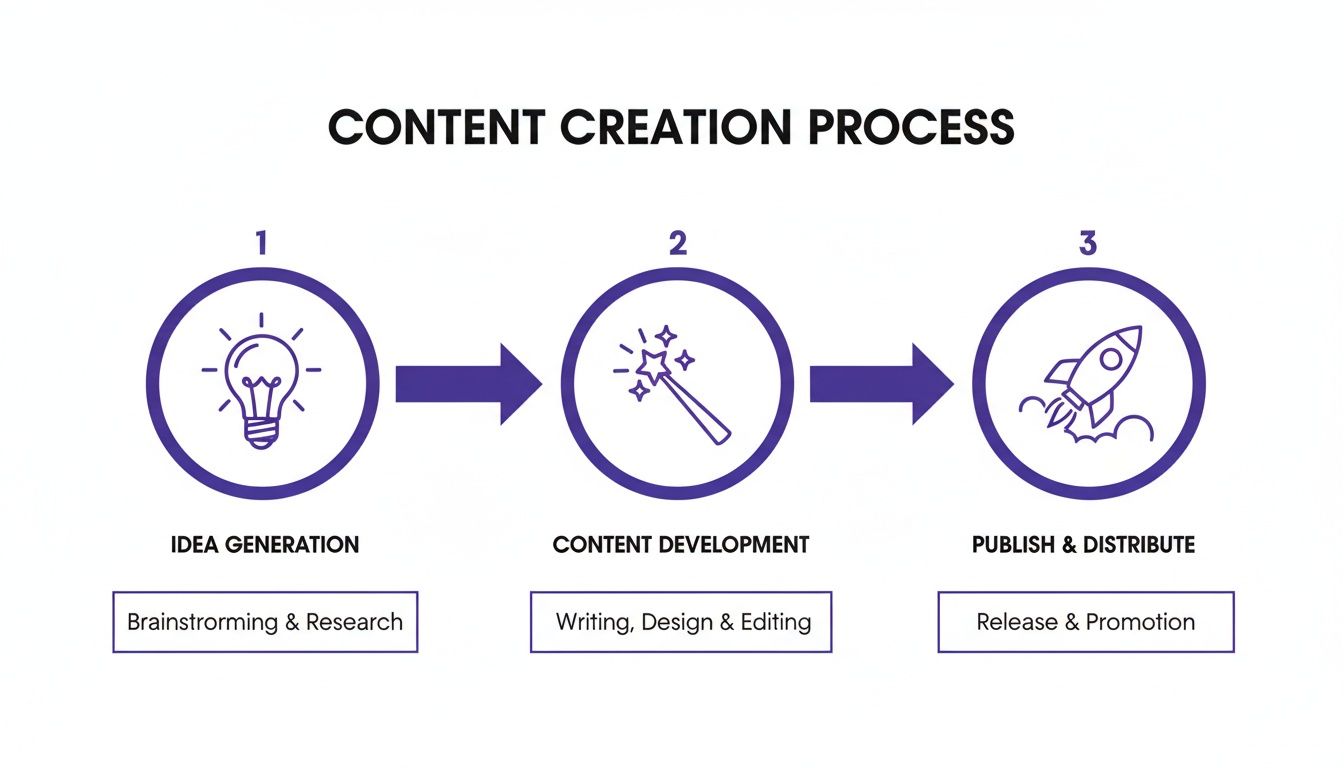
As the diagram shows, you can move from a basic idea to a polished, publishable image incredibly quickly.
Writing Your First Prompt
Ready? Let’s make something together right now. The secret to a great first result is a descriptive but straightforward prompt. You don't need to be a coding wizard; you just need to describe what you want to see.
For this first attempt, we'll aim for something specific and atmospheric. In the prompt box, type this:
A bright, minimalist office with a large window overlooking a futuristic city at sunset, digital art style
This prompt works well because it gives the AI clear instructions on a few key things:
- Subject: A minimalist office with a window view.
- Setting: A futuristic city at sunset, which tells the AI a lot about color and lighting.
- Style: Digital art, which guides the overall aesthetic.
Now, hit the "Generate" button. In less than a minute, the AI will deliver a few different takes on your scene. That's it! You've just created your first piece of AI art.
This kind of immediate, satisfying result is exactly why tools like the free AI art generator from AI Media Studio are so powerful for creators. That first successful image gives you the confidence to start experimenting with more complex prompts and really push the creative boundaries.
Mastering The Art Of The Perfect AI Prompt
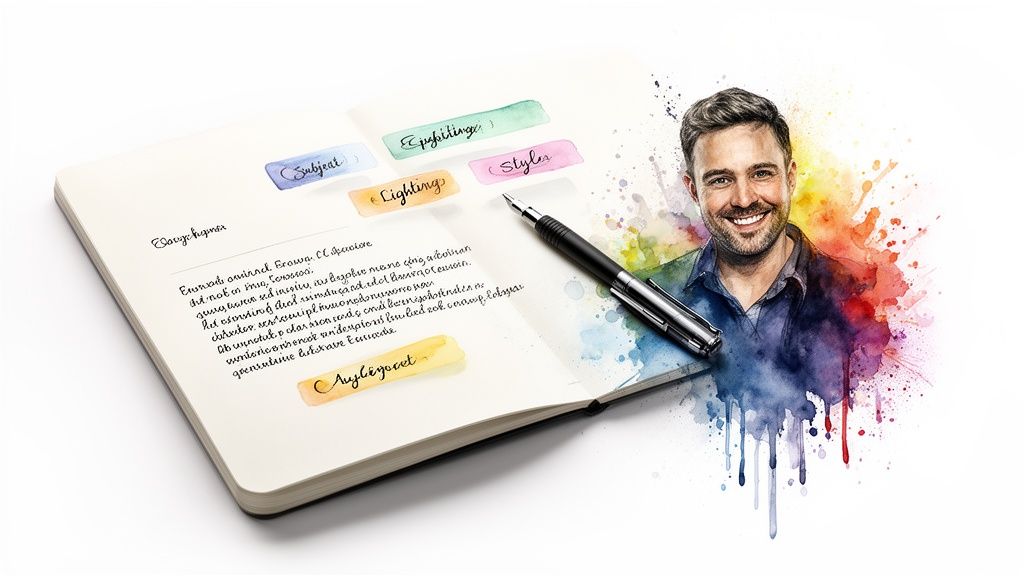
This is where a free ai image creator stops being a toy and becomes a serious creative tool. Your text prompt is the direct line to the AI's "imagination," and the quality of what you say determines the quality of what you get back. Think of it less like giving a command and more like painting a vivid picture with your words.
A truly effective prompt isn't just one long, rambling sentence. It’s a carefully assembled collection of clear, descriptive pieces that all work together. The AI needs to understand not only what you want to see but also how it should look and feel. That means breaking your idea down into its essential parts.
The Anatomy of a Powerful Prompt
Every incredible AI image I've ever generated started with a solid prompt structure. While there isn't some secret, magic formula, the best prompts almost always contain a mix of the same core building blocks.
When you consciously include these details, you’re handing the AI a much clearer blueprint to work from. This dramatically boosts your chances of getting exactly what you want on the very first try.
- Subject: This is the "who" or "what." Be specific. Don't just say "a dog"; try "a fluffy Corgi puppy with oversized ears."
- Action: What is the subject doing? Is it just "sitting" or is it "chasing a glowing butterfly through a sun-drenched meadow"?
- Setting: Where is all this happening? Describing the environment adds incredible depth. "On a futuristic chrome throne" is way more interesting than just "on a chair."
- Artistic Style: This is a big one—it sets the entire mood. Are you after a "photorealistic" image, a "watercolor painting," a "retro anime style," or "cyberpunk concept art"?
- Lighting & Atmosphere: Think about the light source. Words like "soft morning light," "dramatic neon glow from street signs," or "moody cinematic lighting" can completely transform the feeling of an image.
The biggest mistake I see beginners make is being way too vague. A prompt like "a picture of a car" will get you a boring, generic result. But "a vintage red sports car speeding down a winding coastal road at sunset, dramatic cinematic lighting, photorealistic" gives the AI a rich, detailed scene to bring to life.
By layering these elements, you build a much more precise request. The more specific details you feed the AI, the less it has to guess, which leads to results that are much closer to what you were picturing in your head.
Practical Prompting For Different Needs
The real magic of a tool like AI Media Studio is its adaptability. The key is to tweak your prompt's ingredients to match the result you need. What works for a tech brand is going to be completely different from what a fantasy author needs.
Let's look at a couple of real-world scenarios:
- For a Tech Startup's Social Media: You need something clean, modern, and innovative. Your prompt might sound like this: “3D isometric illustration of a team collaborating around a futuristic data dashboard, minimalist design, clean white background, brand colors of blue and purple, corporate art style.”
- For a Fantasy Author's Book Cover: Here, you're going for something epic and atmospheric. The prompt would be completely different: “An epic fantasy landscape with a lone knight standing on a cliff overlooking a stormy sea, dramatic clouds, moody cinematic lighting, digital painting, in the style of Frank Frazetta.”
Notice how both prompts use the same core components—subject, setting, style—but the specific keywords create wildly different images. Getting good at this is what separates casual users from the pros who can generate amazing, on-brand visuals every single time.
To make it even easier, I've put together a quick cheat sheet you can reference anytime you're building a prompt.
Prompt Component Cheat Sheet
This table breaks down the essential parts of a great prompt. Use it as a quick-reference guide to make sure you're giving the AI all the information it needs for a fantastic result.
| Component | Purpose | Example Keyword |
|---|---|---|
| Subject | Defines the main focus of the image. | A majestic lion, a busy city street |
| Action | Describes what the subject is doing. | Running through a forest, typing on a laptop |
| Style | Sets the overall artistic aesthetic. | Photorealistic, 3D render, watercolor |
| Lighting | Controls the mood and time of day. | Golden hour, neon glow, soft studio light |
| Detail | Adds specific, unique elements. | Wearing a top hat, with intricate patterns |
| Camera | Specifies the shot type or angle. | Wide-angle shot, macro detail, aerial view |
By keeping these components in mind, you’ll be crafting detailed, powerful prompts in no time, moving from basic generations to creating truly stunning and specific works of art.
Refining Your Images with Advanced AI Tools
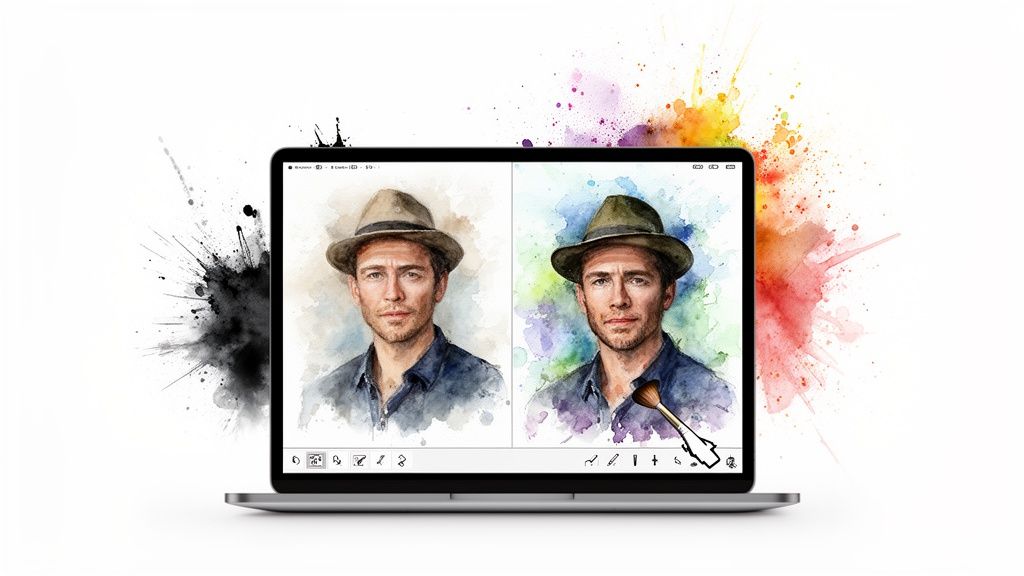
Once you’ve got a handle on writing a solid prompt, it's time to dig into the advanced tools. This is where a truly professional free AI image creator really shines, letting you move beyond just generating images and start refining them with almost surgical precision—all without opening another program.
Two of the most powerful tools in your arsenal are inpainting and outpainting. They sound technical, but they're incredibly intuitive once you try them.
Think of inpainting as your magic eraser and paintbrush rolled into one. It lets you select a specific part of an image you've already made and change it with a new prompt. Let's say you created a perfect portrait, but now you think the subject should be wearing a hat. Instead of starting from scratch, you just mask their head and type "add a stylish fedora." The AI redraws only that section, blending it seamlessly.
Outpainting, as you might guess, does the exact opposite: it expands your canvas. If you’ve got a fantastic close-up but need a wider landscape version for a website banner, this is your go-to. Outpainting extends the image's borders, and the AI intelligently fills in the new space, creating more of the scene in the same artistic style. It’s an absolute lifesaver for repurposing visuals.
Exploring a Universe of Art Styles
Beyond just editing, the sheer variety of available art styles can completely transform your work. A platform like AI Media Studio has a huge library where one prompt can spit out wildly different results depending on the style you pick.
This kind of stylistic control is a big reason these tools have taken off so quickly. The market for image and video generative models hit USD 4,628.2 million in 2024 and is on track to reach an incredible USD 27,739.8 million by 2030. That growth is fueled by creators who need these advanced style features to crank out unique, on-brand visuals.
Here’s a quick look at how a single prompt can evolve:
- Prompt:
A lone astronaut gazing at a swirling nebula - Style: Photorealistic -> You'll get a crisp, detailed image that looks like it came straight from NASA.
- Style: Anime -> The result is a vibrant, dynamic scene with classic Japanese animation flair.
- Style: Watercolor -> This renders a soft, dreamy painting with beautiful blended colors and textures.
- Style: Abstract -> The AI interprets the idea with shapes and colors instead of a literal picture.
The ability to instantly test a dozen different art styles for the same core idea is a massive creative accelerant. It allows for rapid experimentation that would take a human artist days or even weeks to replicate.
Practical Tips for Refining Your Work
Getting the most out of these advanced features just takes a bit of practice. When you’re using inpainting, try making your selection mask slightly larger than the area you want to change. This little trick helps ensure a smoother, more natural blend.
For outpainting, it's often better to expand the image in smaller steps rather than all at once. This gives the AI more context to work with, leading to a much more coherent final picture.
The real magic, though, happens when you start combining these tools. To get a better sense of what's possible, you should check out the full capabilities of an advanced AI image editor and see how it can slot into your own creative workflow.
Understanding Licensing and Commercial Use
Making an amazing image with a free AI image creator is just the first step. The real question—and the one that matters most for any professional—is what you can legally do with it. This is where licensing comes in, and ignoring it can have serious consequences for your business or personal brand.
Many free trials, including the starter credits you get with AI Media Studio, are perfect for personal use. You can generate stunning visuals for your own projects, test out wild ideas, or just get a feel for the tool. But the second you plan to use an image to sell a product, run an ad, or put it on a monetized website, you've entered the world of commercial use.
Why Commercial Rights Matter
For any professional, from a freelancer building a portfolio to a marketing team launching a new product, securing commercial use rights is non-negotiable. Using an image for business purposes without the proper license can lead to legal headaches and financial trouble you just don’t need. This is exactly why platforms like AI Media Studio draw a clear line between their free and paid tiers.
When you upgrade to a paid plan, you're buying more than just extra credits or higher resolution. You're buying the legal right to use your AI-generated images to make money.
- For a Startup: Let's say you use batch generation to create 50 unique images for a new product launch. A commercial license means every single one of those visuals can be used in social media ads, on your website, and in email campaigns without you losing a wink of sleep.
- For a Content Creator: If you run a monetized blog or YouTube channel, a commercial license ensures the thumbnails and featured images you create are fully compliant, protecting your hard-earned revenue.
The real value of a paid tier is peace of mind. It turns a fun AI tool into a reliable, legally sound business asset that protects you and your clients.
Exporting and Sharing Your Work
Once you’ve nailed your creation and have the right license, a professional-grade tool makes the final steps dead simple. AI Media Studio lets you download in high resolution, ensuring your images look sharp whether they’re printed on a flyer or splashed across a 4K monitor.
Better yet, many tools have direct sharing integrations built right in. This cuts out the annoying step of downloading and re-uploading, letting you push your new visual content to platforms like Instagram or LinkedIn with just a few clicks. For teams managing a bunch of different accounts, that kind of streamlined workflow is a huge time-saver.
Finally, let's talk about privacy. When you're working on proprietary campaigns or sensitive client projects, you need to know your work is confidential. Reputable platforms ensure that your prompts and the images you generate are kept private—a standard and essential feature of any professional account.
Common Questions About Free AI Image Creators
Jumping into the world of AI image generation is exciting, but it’s natural to have a few questions. From figuring out who owns the images to whether free tools are any good, it’s smart to get the lay of the land first. Let's clear up some of the most common queries.
The big one everyone asks is about ownership: if I make an image with a free tool, is it really mine? The answer comes down to the platform's terms. With AI Media Studio, for example, anything you create with free credits is usually meant for personal, non-commercial fun. If you want to use those visuals for your business—say, in an ad or on a monetized blog—you’ll need the commercial license that comes with a paid plan.
Getting this right is a huge deal for protecting yourself and your brand from legal headaches. Before you ever use a generated image for business, make it a habit to check the terms of service.
Can Free Tools Create High-Quality Images?
Absolutely. The AI models powering top-tier platforms are incredibly potent, even on their free plans. A free ai image creator like AI Media Studio isn't giving you a watered-down version of its core tech; you’re tapping into the same powerful engine that paying customers use.
The real difference isn’t in the potential quality, but in the limits. Free access typically means you’ll run into:
- A cap on your monthly generations or credits.
- Standard-resolution downloads instead of the ultra-high-res options.
- A watermark on the final images.
So, while you can definitely create some jaw-dropping, high-quality visuals, the free experience is really a test drive to show you what the platform can truly do when you take the brakes off.
Is My Data and My Prompts Kept Private?
This is a totally valid concern, especially if you’re cooking up sensitive or proprietary ideas for your business or a client. Any reputable AI platform takes this very seriously.
With AI Media Studio, your prompts and the images you create are treated as your private data. They aren't used to train the public AI models or shown to other users, so your creative work stays confidential.
This kind of privacy is standard for professional-grade tools. It’s what lets teams experiment with new campaign concepts or product mockups with confidence, knowing their intellectual property is safe. Be wary of lesser-known or totally free-for-all platforms, as they might not offer that same guarantee. It always pays to stick with established providers.
Ultimately, a free ai image creator is a fantastic gateway. It lets you learn the ropes, play with ideas, and see how AI can fit into your workflow without spending a dime. Once you see the value, upgrading for commercial rights and more powerful features becomes a pretty easy decision for any serious creator or business.
Ready to bring your ideas to life? Start creating professional-quality images in seconds with AI Media Studio. Get your first free generations on us and see what you can make today. Explore the possibilities at https://www.ai-media-studio.com.