AI fruit videos
AI fruit video generator: make your own fruit drama series
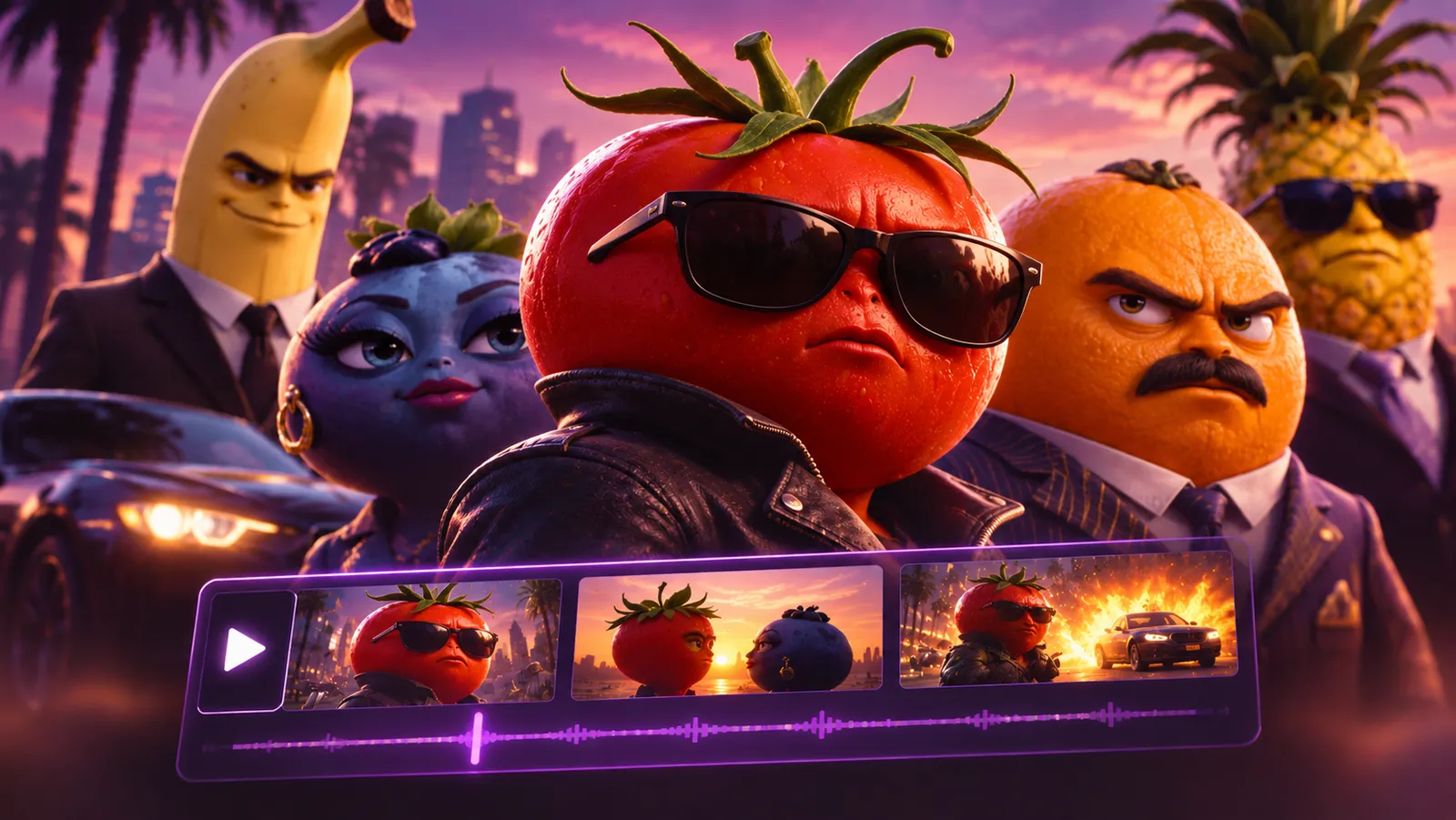
AI fruit videos are short clips in which cartoon fruit with faces, arms and legs act out stories: soap-opera drama, dating-show scenes, family moments and memes, often posted as a series of short vertical episodes. To make one, design your fruit characters as an image, turn each scene into a still, and animate it on Kling 4.0, the video composer's default model. A 5-second clip at 720p costs 115 credits, with sound.
Every edit needs a paid plan. Plans start at $19/month. Paid plans include a commercial license.
How do I make an AI fruit video?
- 01
Design your fruit cast as an image
Generate a character sheet in the image composer: each fruit from the front, side and back, with a few expressions. On Nano Banana Pro it costs 30 credits. This sheet is what keeps your characters the same from episode to episode.
- 02
Turn each scene into a still
Attach the character sheet as a reference and describe the scene: who is there, where they stand, what they feel. One still per scene becomes the first frame of that clip.
- 03
Animate the scene with Kling 4.0
Open the Video tab, attach the still and describe one thing that happens, how the camera moves and what must stay the same. Kling 4.0 makes clips of 3 to 15 seconds with sound.
- 04
Cut the episode together
Put several clips in order in your video editor, add captions, and end on an open question so viewers want the next part. Narration or music from the Audio studio can go on top in the same editor.
AI fruit video ideas, with prompts
Each idea has a prompt you can copy. Swap the fruits, the place and the twist for your own story; keep the style words so every episode looks the same.
1.Design your fruit cast first
Before any video, make one image that shows every character from several sides and with several expressions. Give each fruit one detail that is easy to spot, such as a bow, glasses or a crown, and describe it with the same words in every later prompt.
Prompt to try
A character sheet of three original cartoon fruit characters for a short drama series, on a plain white background: a strawberry with big expressive eyes and a small red bow, a lemon in round glasses, and a tall pineapple with a leafy crown. Each fruit has small arms and legs and is shown from the front, the side and the back, with three facial expressions: happy, shocked and sad. Soft 3D animation style, consistent colors, no text.
Suggested model: Nano Banana Pro
2.A fruit drama episode that ends on a cliffhanger
The classic fruit drama: a secret, a phone, someone in the doorway. Make the still with the character sheet attached, then animate it and stop the clip on the reaction. The next episode answers the question.
Prompt to try
The strawberry slowly lowers the phone and turns toward the doorway, eyes wide. The lemon steps into the light and freezes. Slow push-in on the strawberry, then hold on her shocked face. No dialogue. Keep both characters and the kitchen exactly as in the image.
Suggested model: Kling 4.0
3.A fruit island dating-show scene
An island, a pool, a new arrival who changes everything. Use your own characters, names and setting rather than those of an existing show. This prompt works as text to video; for a returning cast, make the still from your character sheet first.
Prompt to try
Cartoon fruit characters in a soft 3D animation style on a sunny tropical beach at sunset: a mango and a kiwi sit side by side on a wooden bench by a pool. A coconut walks in carrying two drinks and stops, surprised. The mango looks from one to the other. Slow sideways camera move, warm light, reality dating show look. No dialogue, no text on screen.
Suggested model: Kling 4.0
4.A fruit family story
Not every fruit story is a scandal. Warm family moments, such as a first step, a birthday or a lost toy found again, work well as a calmer series.
Prompt to try
A cartoon family of apples in a soft 3D animation style in a sunny kitchen: the mother and father apple kneel and hold out their arms as their small apple child takes its first wobbly steps toward them, then they cheer and hug. Warm morning light, static camera. No dialogue, no text on screen.
Suggested model: Kling 4.0
5.A fruit meme reaction
A single fruit, one exaggerated reaction and a hold at the end, so you can add your own caption on top. Short clips of 3 to 5 seconds suit this format.
Prompt to try
A cartoon banana with big eyes sits on a couch holding a bowl of popcorn, watching TV. It slowly turns to the camera with a deadpan face and raises one eyebrow, then holds the stare. Soft 3D animation style, static close-up. No dialogue, no text on screen.
Suggested model: Kling 4.0
6.A fruit transformation in several stages
For a change in several steps, make one image per stage and add them as keyframes on FLUX 3 Max. It takes up to 10 images and moves through them in order over a 5 to 20-second clip. It joined the studio in November and we have not tested it on fruit characters yet.
Prompt to try
Move through the keyframes in order: a small green unripe banana character, then the same banana ripe, yellow and smiling, then the same banana in sunglasses posing proudly. Each stage turns smoothly into the next on the same kitchen counter. Static camera. Keep the face and the animation style the same.
Suggested model: FLUX 3 Max
Tips for a fruit series that stays consistent
- Attach the same character sheet to every scene still, and describe each fruit with the same words every time.
- To put two or three characters into one clip from separate images, attach up to 3 reference images in the Video tab. That runs reference-to-video on Kling O3 Pro, because Kling 4.0 does not take references.
- One action per clip, 5 to 10 seconds long. A long scene is easier to fix as several short clips than as one long one.
- For TikTok, Instagram Reels and YouTube Shorts, make the stills in 9:16: image to video starts from the still, so a vertical still gives a vertical clip.
- Keep the stories family friendly: jealousy, secrets and cliffhangers carry the format without anything explicit.
- Use your own characters, names and settings, and label AI content where the platform asks for it.
Which video model to use for fruit characters
Prices are per second of video in the web app. Kling 4.0 is the default in the Video tab.
| Model | Credits per second | On Starter | Use it for |
|---|---|---|---|
| Kling 4.03 to 15 s, 720p, with sound | 23 | $0.437 | Our pick and the default: keeps illustrated looks steady. 34 credits per second at 1080p. |
| Kling O3 Pro3 to 15 s, audio off | 17 | $0.323 | Up to 3 reference images, for scenes with several characters from separate images. |
| Grok Imagine Video 1.5720p, with sound | 21 | $0.399 | Livelier motion from a still. |
| Seedance 2.0720p | 44 | $0.836 | Top quality at a higher price. Declines images with a real-looking human face. |
| FLUX 3 Max5 to 20 s, 720p, with sound | 25 | $0.475 | Up to 10 keyframes in one clip. Not tested by us yet. |
The editor shows the credit cost before you generate. Prices checked .
What an AI fruit video costs
A 5-second clip on Kling 4.0 costs 115 credits at 720p, and a 10-second clip 230. The character sheet and each scene still cost 30 credits on Nano Banana Pro. An episode of 4 scenes of 5 seconds, with its character sheet, comes to about 610 credits if every clip works the first time.
Plans start at $19/month. Downloads carry no watermark, and paid plans include a commercial license.
Frequently asked questions
What are AI fruit videos?
Short AI-generated clips in which fruit with faces, arms and legs behave like people: they fall in love, argue, keep secrets or react to something. Most are vertical videos for TikTok, Instagram Reels and YouTube Shorts, and many are told as a series of short episodes.
What is AI Fruit Love Island?
Fruit Love Island is an AI-generated microdrama web series that an anonymous creator account posted on TikTok and YouTube from March 2026. Anthropomorphic fruits compete in a dating reality show modeled on Love Island, living together in a villa, with audience votes on some outcomes. It drew wide attention and criticism, and its creator stopped new episodes at the end of March 2026. AI Media Studio is not affiliated with it; this page shows how to make your own fruit characters and stories.
How do I make an AI fruit video?
Design your fruit characters as one character sheet image, make a still of each scene with the sheet attached as a reference, then animate each still with image to video on Kling 4.0. Join the clips in your video editor and add captions.
What is an AI fruit drama?
A soap-opera story told with fruit characters: love triangles, betrayals, secrets and cliffhangers, split into short episodes. Each AI fruit story works best as several clips of 5 to 15 seconds, one moment per clip.
Can I make my own AI fruit island show?
Yes, with your own characters, names and setting. Make a character sheet for your cast, a still of the island setting, and one clip per scene. Do not copy the characters, names or logos of an existing show.
How do I make an AI fruit meme?
Describe one fruit, one exaggerated reaction and a hold at the end, generate a 3 to 5-second clip with text to video, and add your caption in your editor or the app you post from.
How do I keep the same fruit characters in every episode?
Start every scene from a still made with the same character sheet attached, and use the same description of each fruit in every prompt. For two or three characters from separate images in one clip, use reference-to-video on Kling O3 Pro with up to 3 reference images.
Can the fruit characters talk?
Not with lip sync: AI Media Studio does not make talking or lip-synced characters. You can tell the story with captions, or make a narration in the Audio studio and put it over the clips in your own video editor.
Is there a free AI fruit video generator?
AI Media Studio has no free tier. Every edit needs a paid plan. Plans start at $19/month. A 5-second fruit clip on Kling 4.0 costs 115 credits at 720p.
Uploads are processed by the AI provider that runs the model you pick. Retention, processors and deletion requests are covered in the privacy policy.